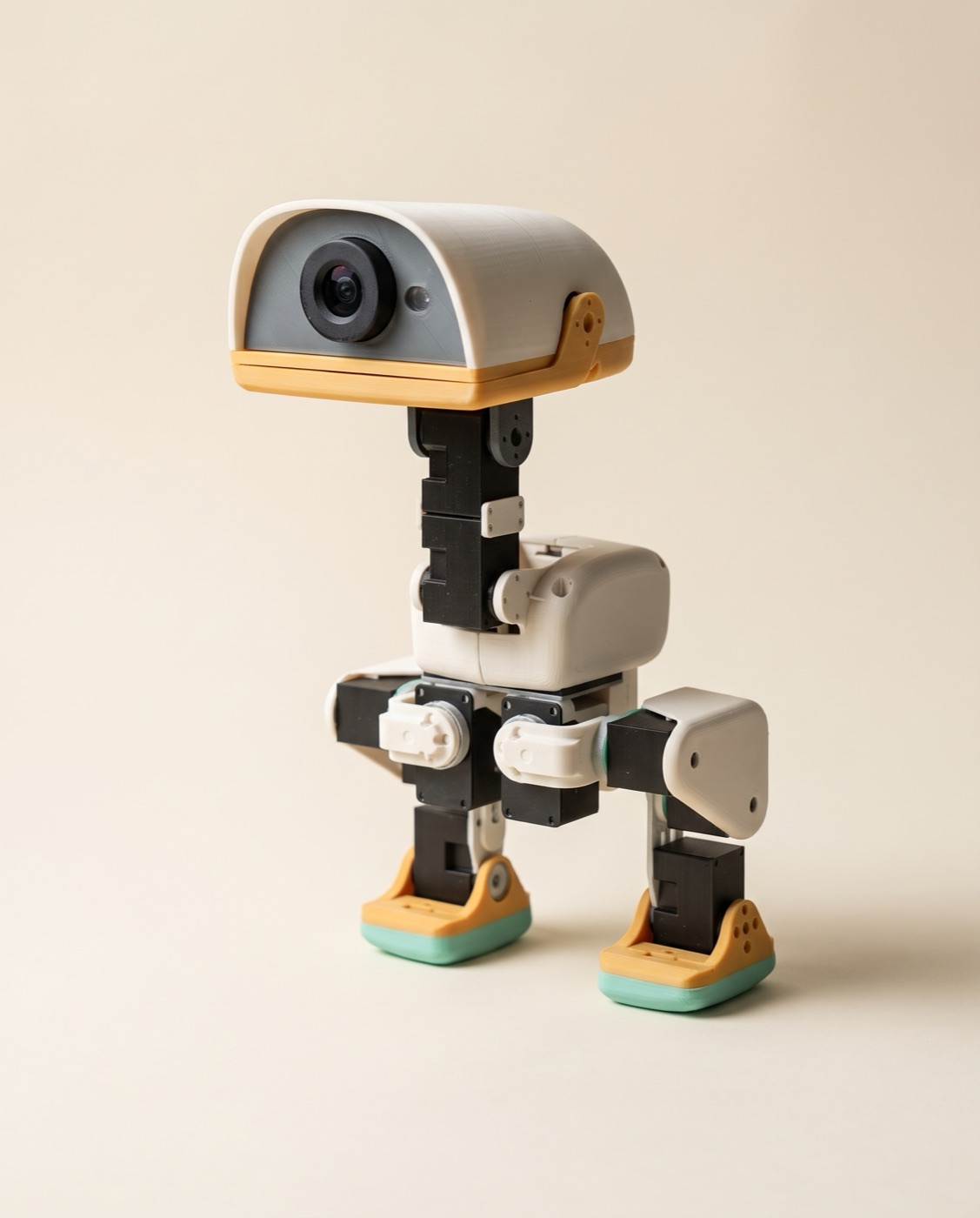
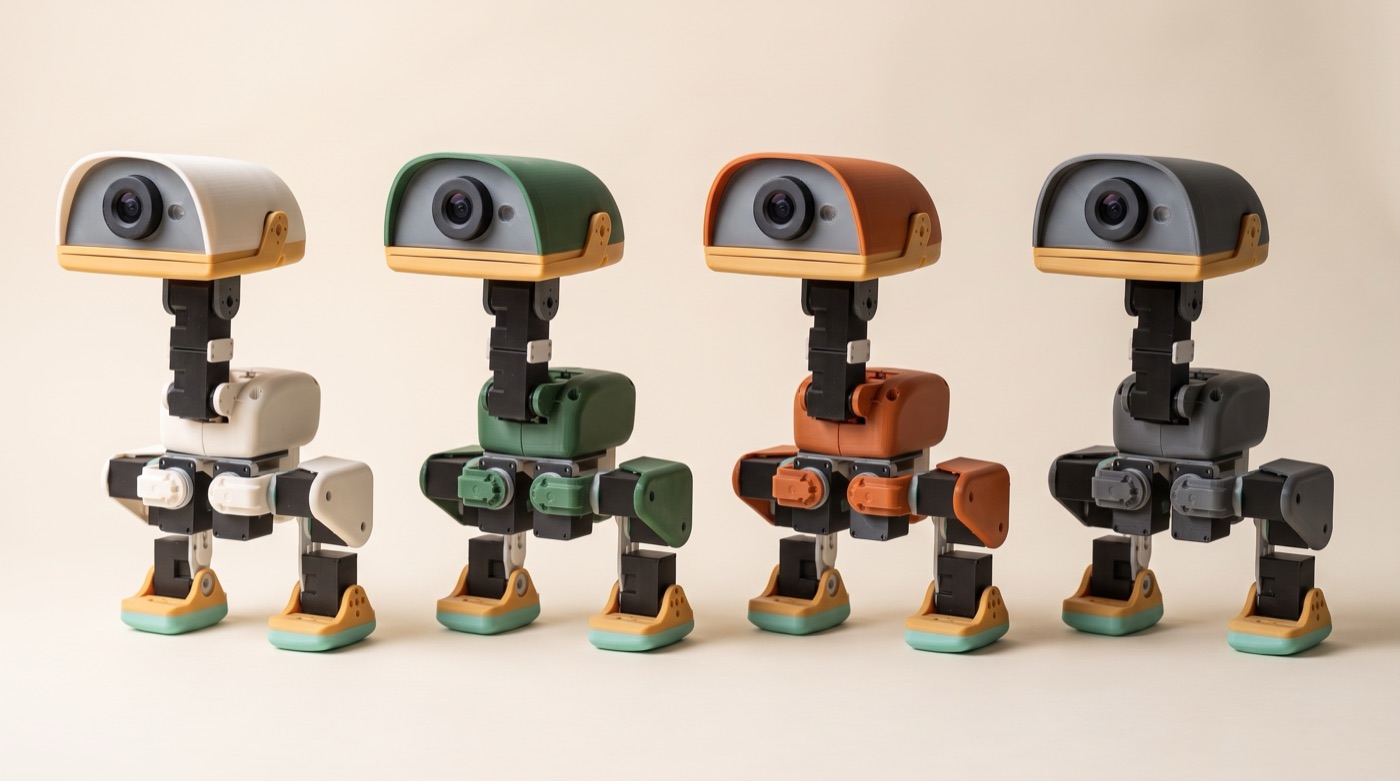
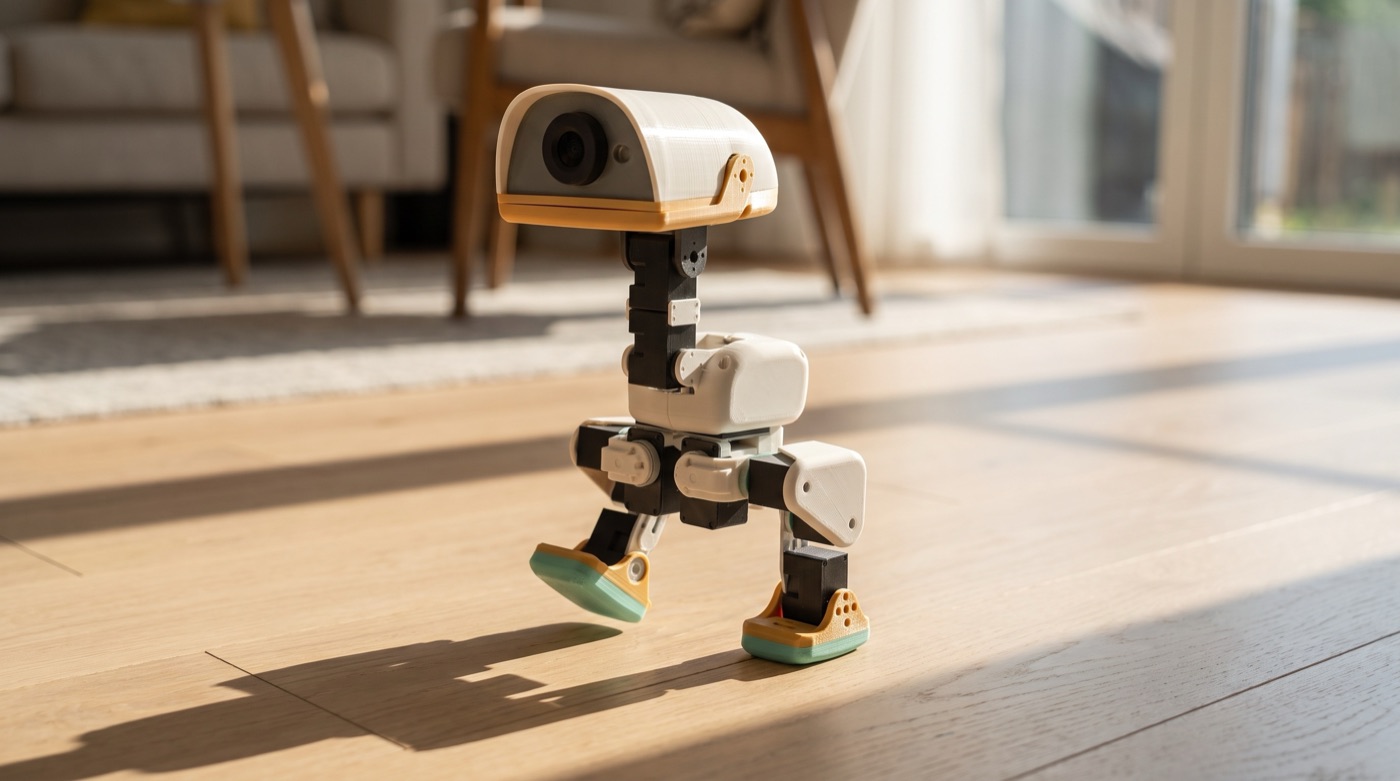
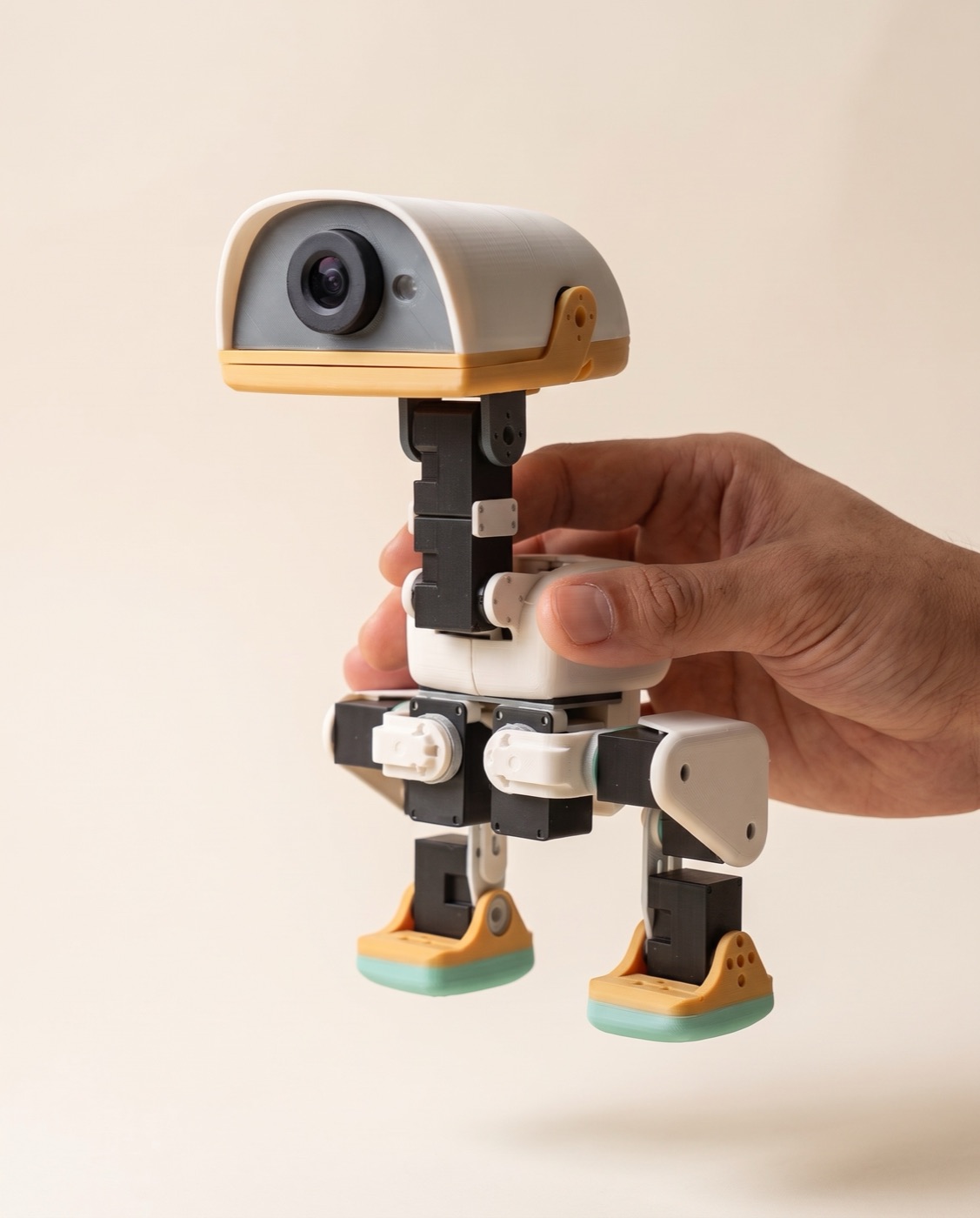
Huey is a small duck that walks. We are building it.
Huey stands 25 cm tall, carries fifteen bus servos, a camera and a beak that opens. We rebuilt the printed parts in our own CAD, checked every one against the original, and the first plates are coming off the printer at Black Ark.
What we need to buyWhere the build stands- 15servos
- 36printed pieces
- 30 / 30part designs checked
- 7 h 19 mbody plate print
Mechanics
Two legs with five joints each, a neck, and a head that pitches, turns and tilts. Every joint is one servo on one shared bus. Ranges below are the ones the simulation model declares.
Each leg, 5 joints
| joint | range |
|---|---|
| hip yaw | 55° total |
| hip roll | ±22° |
| hip pitch | ±90° |
| knee | ±90° |
| ankle | ±90° |
Neck and head, 4 joints
| joint | range |
|---|---|
| neck pitch | −90° to +60° |
| head pitch | ±90° |
| head yaw | ±170° |
| head roll | ±25° |
Beak, 1 joint
The fifteenth servo sits inside the head and opens the jaw from −5° closed to +30° open. The soft lip and the foot soles print in TPU; everything else prints in PLA.
The knee and hip-pitch axes sit 42 mm apart inside one thigh housing.
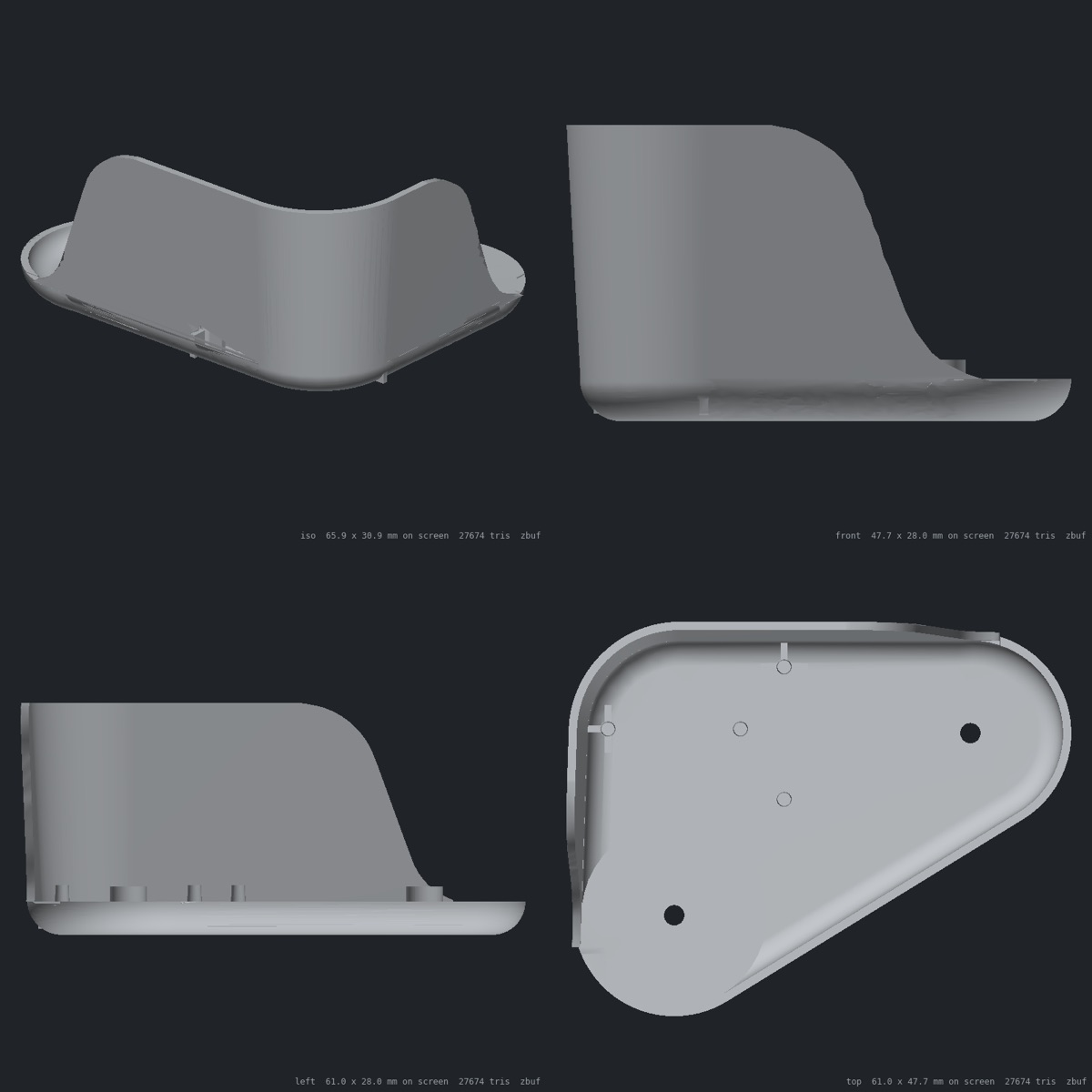
One cup holds two servos. Rebuilt in CAD, 4223 mm³.
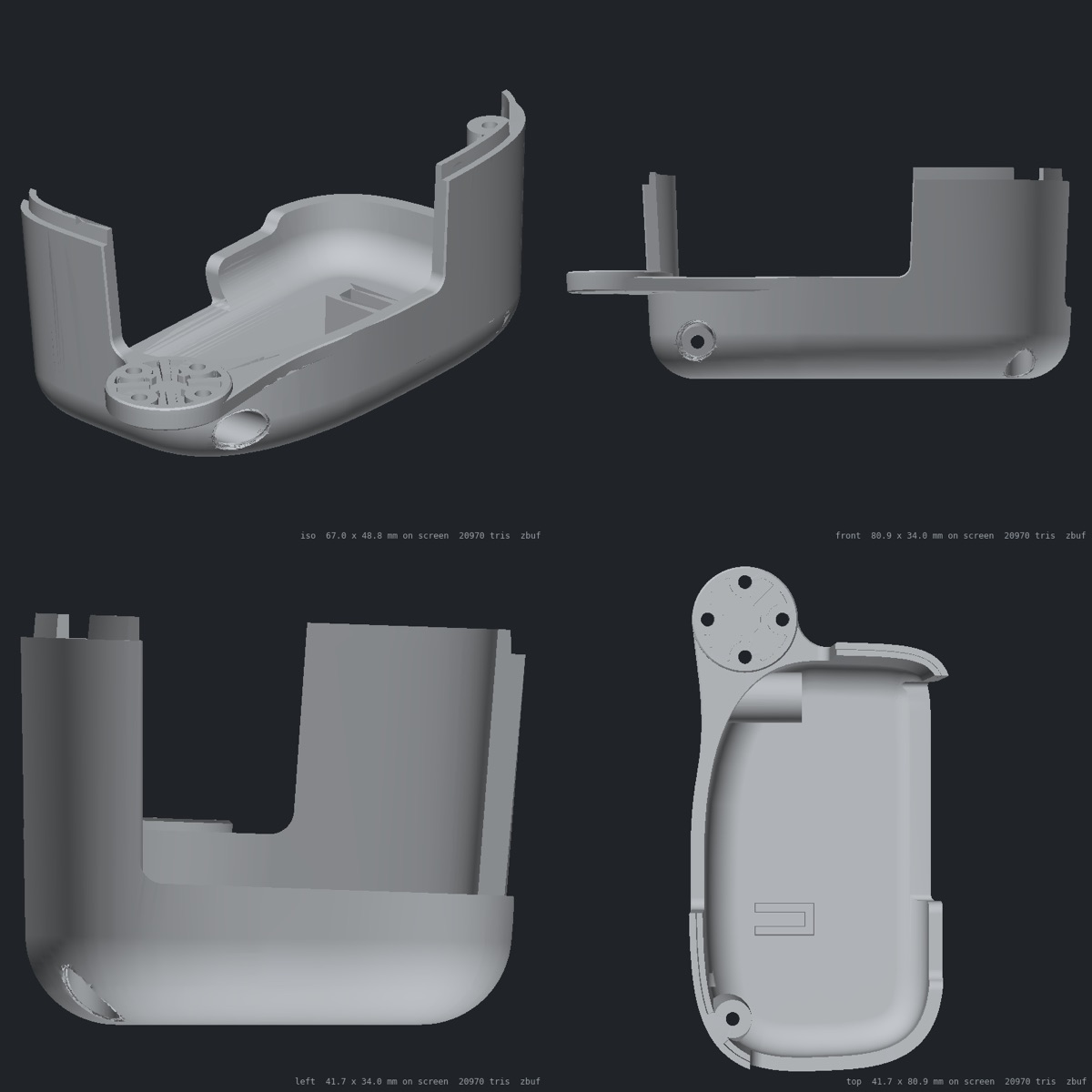
Left and right halves close round the battery and boards.
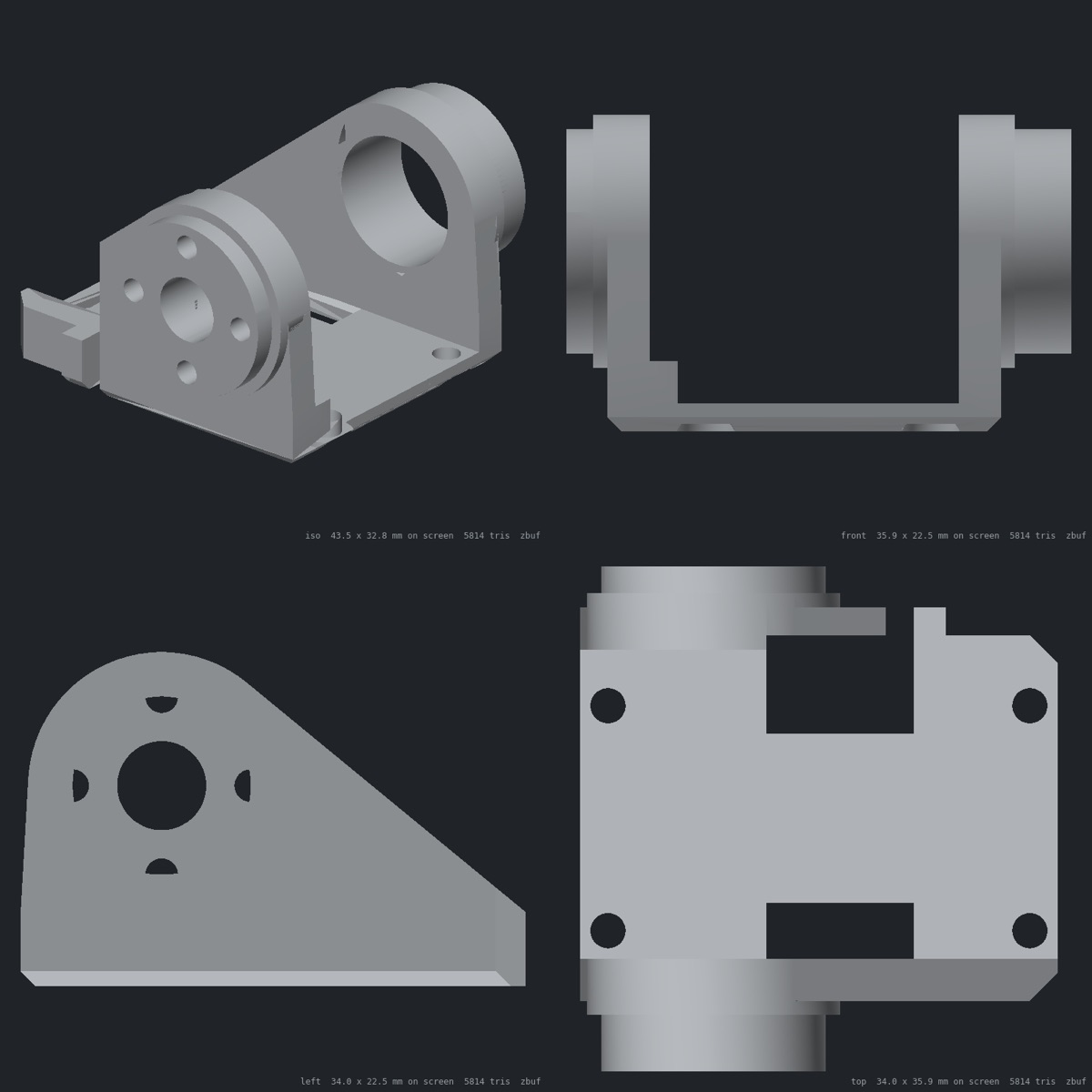
Two bearing bores, four corner holes, four horn slots.
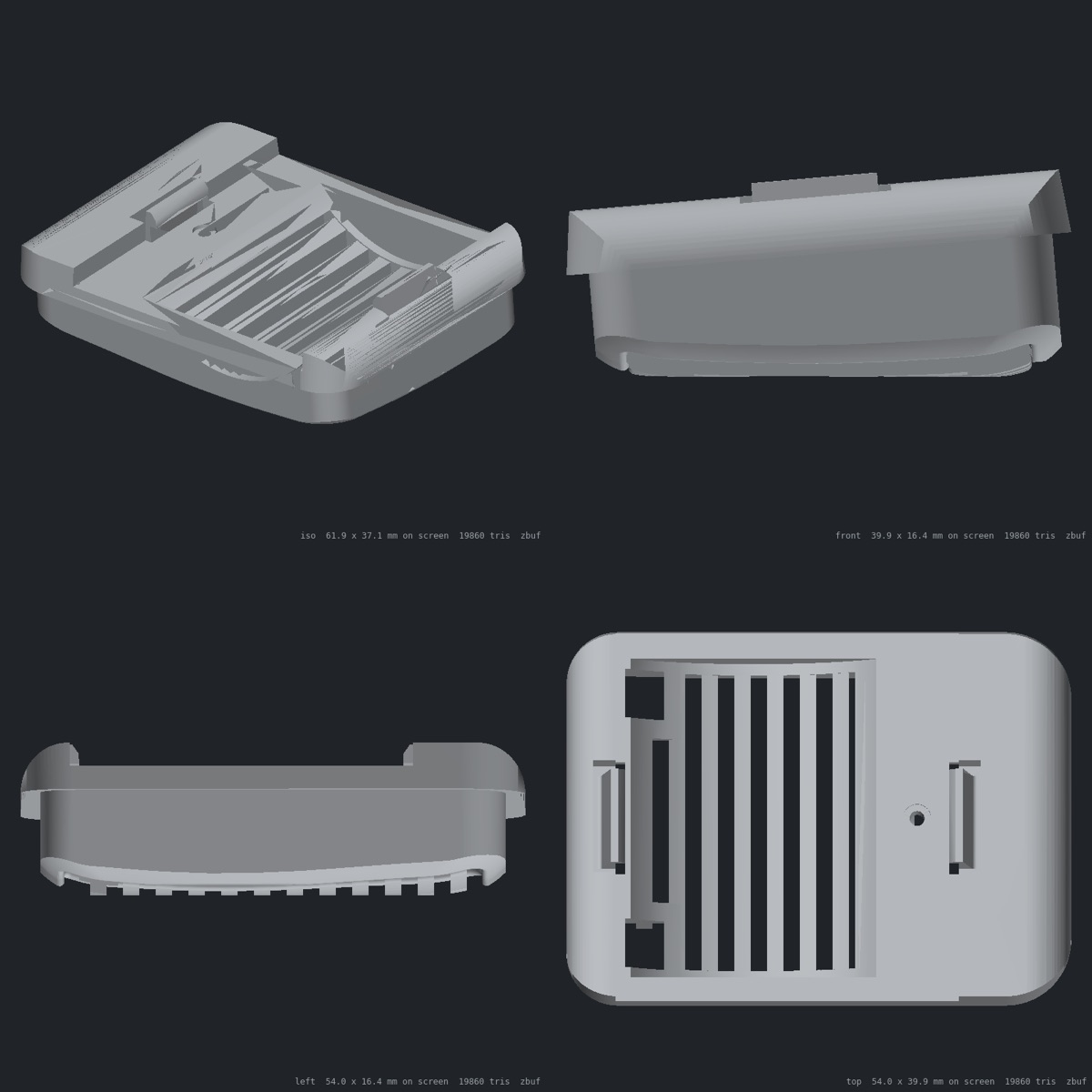
Hard cap in PLA, 12.9 mm TPU sole under it.
The servo
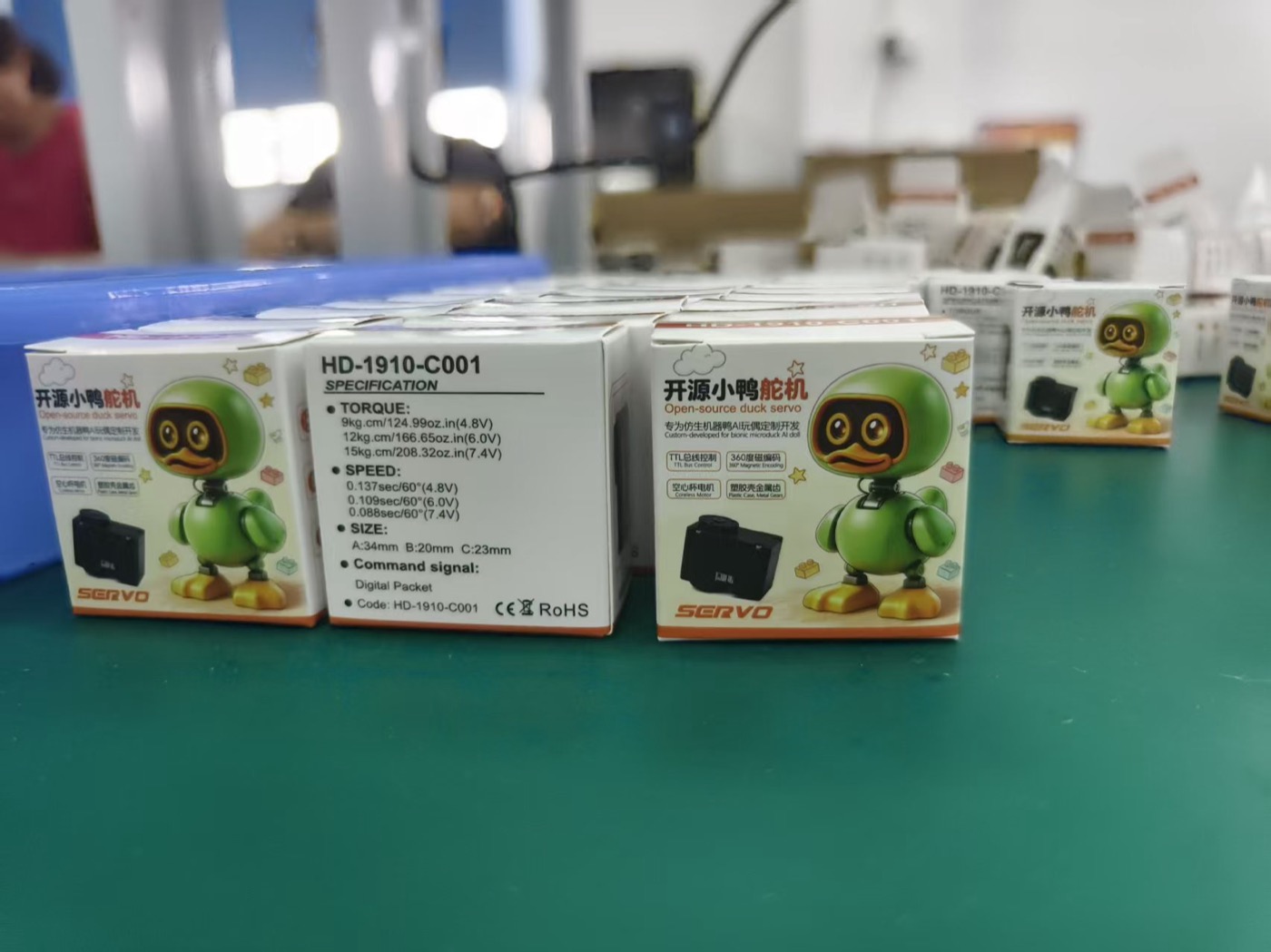
The original design uses fifteen Dynamixel XL330 servos at about $24 each. We have fifteen Feetech HD-1910-C001 in hand instead. Feetech drew it to the same envelope, so no printed part changes.
| XL330, as modelled | HD-1910-C001 | |
|---|---|---|
| body | 34 × 20 × 23 mm | 34 × 20 × 23 mm |
| across horn and idler | 29 mm | 29 mm |
| axis from the near end | 9.5 mm | 9.5 mm |
| corner holes | 16 × 30 mm | 16 × 30 mm |
| stall torque | 0.52 N·m at 5 V | 12 kg·cm at 6 V (1.18 N·m) |
| voltage | 3.7 to 6.0 V | 4 to 8.4 V |
| weight | 18 g | 21 ± 2 g |
| bus | Dynamixel Protocol 2.0 | Feetech TTL packet, 1 Mbps |
| price, each | $23.90 | ¥104 |
| price, 15 for one robot | $358.50 | ¥1,560 |
HD-1910 numbers are from Feetech's spec sheet, edition A/0, 2026-09-07. We have not yet put calipers on one. Noah bought the fifteen at ¥104 each.
Where the build stands
Updated 2026-09-17.
- ✓Head plate printed. Eleven PLA pieces, 8 h 36 m on the H2D. One of them, the head yaw bracket, came from a low-detail file and is being reprinted.
- ✓Every printed part checked against the original. All 30 part designs were rendered beside the published mesh and judged. Four defects found and fixed the same day: both upper legs, the power support and the head yaw bracket.
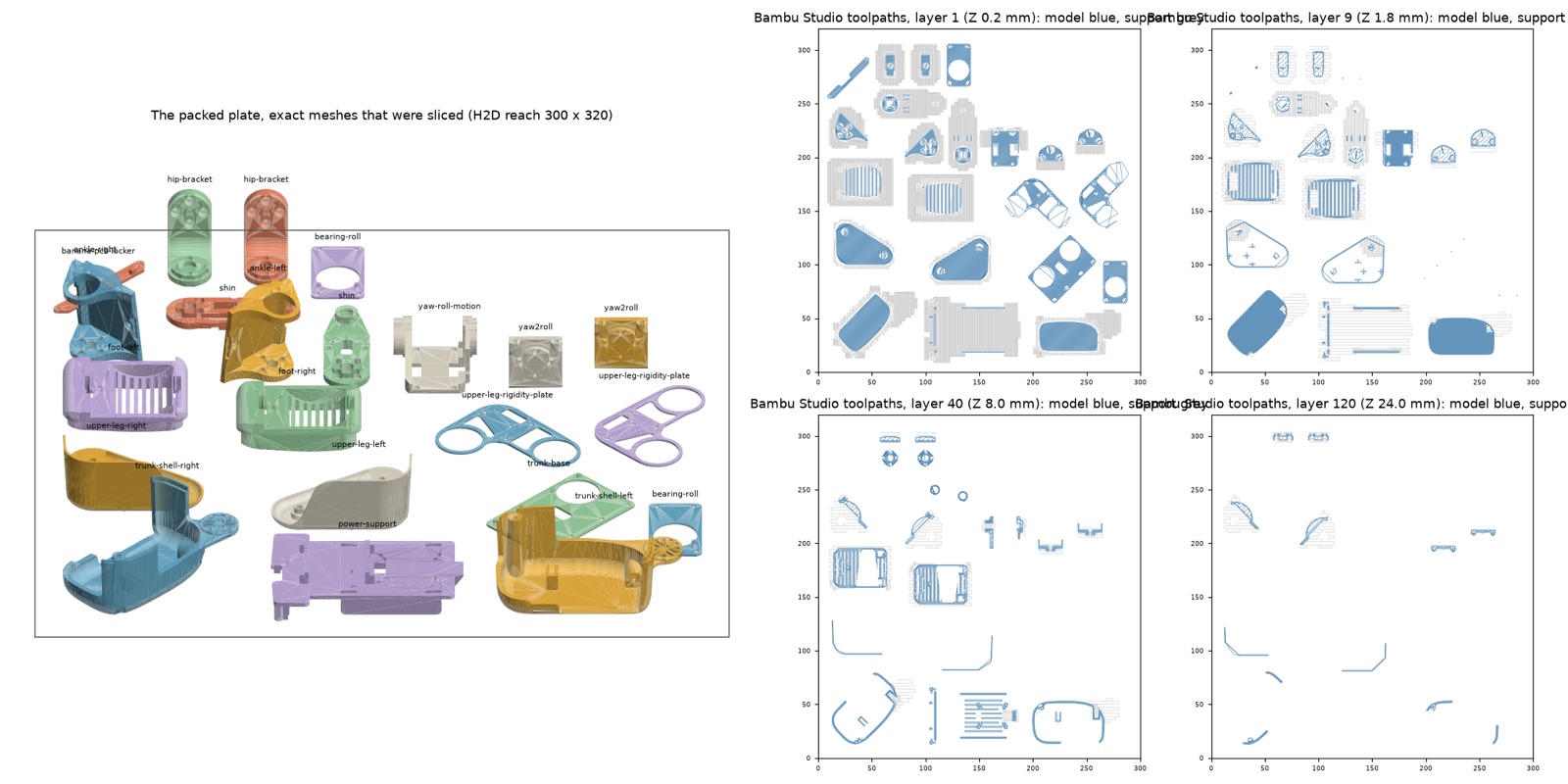
- →Body plate ready. Twenty-two pieces on one plate, sliced in Bambu Studio for the H2D, 153 g of PLA, 7 h 19 m, validated against the live printer. It prints when a printer is free.
- 4Soft parts. Two soles, the soft jaw and the mouth top need TPU loaded on a printer.
- 5Three boards to design. The robot hat, the IMU board and the battery contact board have no design files yet.
What we need to buy
For one robot. Screw counts include spares and come from hole counts on the 3D models, so expect small changes after the first build.
Mechanical
| part | qty | |
|---|---|---|
| Ball bearing MR1622-ZZ, 22 × 16 × 4 | 11 | buy |
| Ball bearing MR6700 open, 15 × 10 × 3 | 3 | buy |
| Screw M2 × 4, socket head, black 12.9 | 60 | buy |
| Screw M2 × 6 | 80 | buy |
| Screw M2 × 8 | 40 | buy |
| Screw M2 × 12 | 15 | buy |
| Screw M2.5 × 6 (servo horn) | 20 | buy |
| Nut M2 | 50 | buy |
| Heat-set insert M2, brass, knurled | 60 | buy |
| Servo horn disc, 25T, Ø16, 8 × M2 | 15 | check the servo box |
| TPU filament 85A to 95A | 0.5 kg | buy |
| PLA filament | 1 kg | have |
| Printed parts, 32 PLA + 4 TPU | 36 | we print |
Electrical
| part | qty | |
|---|---|---|
| Servo Feetech HD-1910-C001, ¥104 each, ¥1,560 | 15 | have |
| Servo bus adapter, Feetech TTL, 1 Mbps | 1 | buy |
| Servo extension lead, AMP 2.0 3-pin | ~8 | length open |
| Radxa Zero 3W, 1 GB / 32 GB eMMC | 1 | buy |
| Battery NP-F550, 2S 2600 mAh | 2 | buy |
| Dual NP-F charger | 1 | buy |
| Camera IMX219, M12 mount | 1 | buy |
| M12 wide-angle lens | 1 | buy |
| 22-pin MIPI CSI ribbon, 100 / 150 / 200 mm | 1 each | buy |
| Distance sensor VL53L8CX breakout | 1 | buy |
| IMU LSM6DSV16X breakout | 1 | buy |
| Audio codec TLV320AIC3104 (LCSC C181753) | 1 | buy |
| Speaker 2 W 8 Ω, about 35 × 25 × 7 | 1 | measure first |
| Microphone module | 1 | open |
| Bluetooth gamepad, USB-C cable, wire, connectors | buy |
The box
Three directions for the kit we send to Hans and Noah. All four pictures are concepts generated from our CAD render and carry known faults: the servo count in the kit tray is wrong, and the mark on the box is rotated. These pictures were made before the robot was named Huey, so nothing is lettered yet.
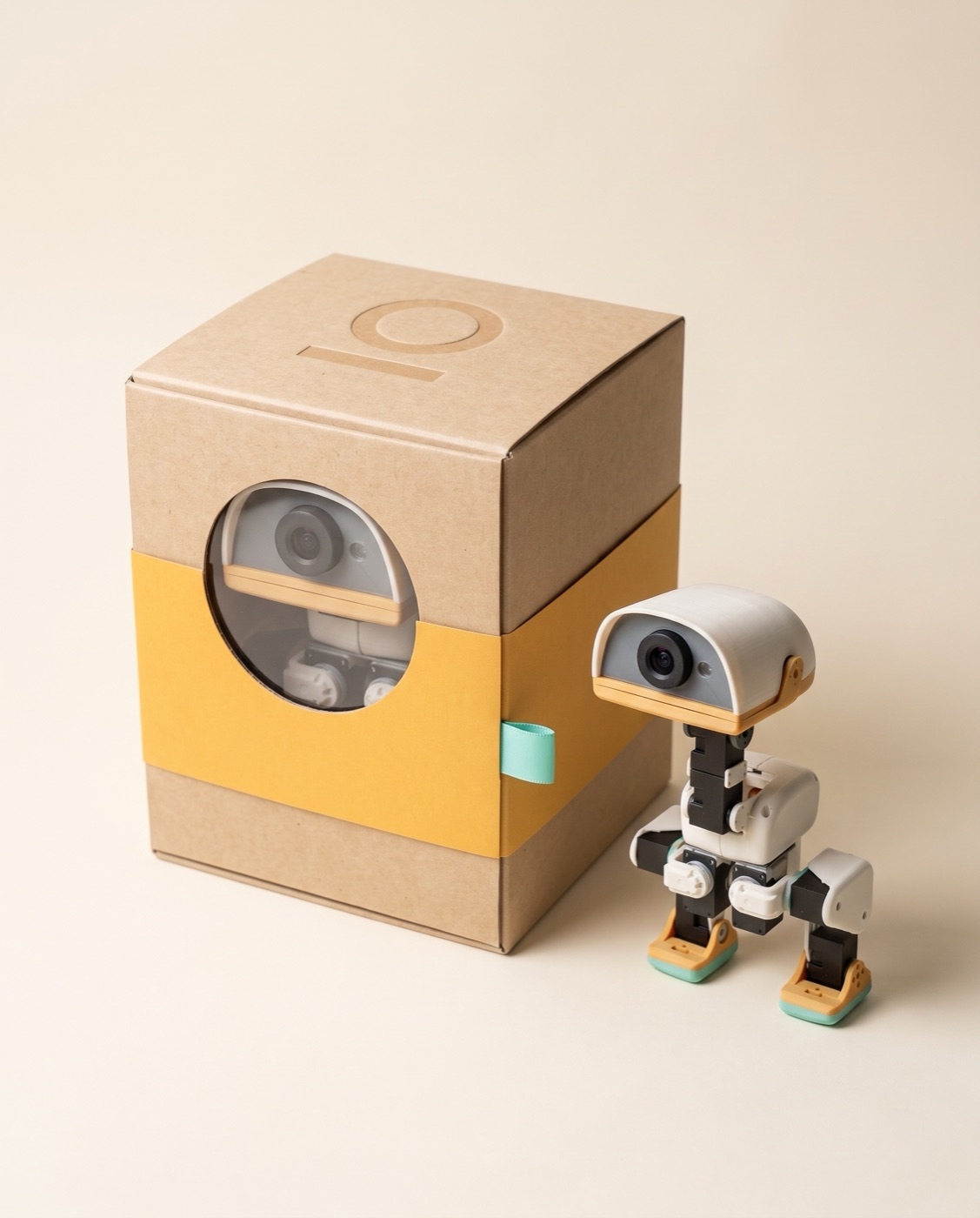
Ivory board, amber belly band, the lens looks out of a round die-cut.
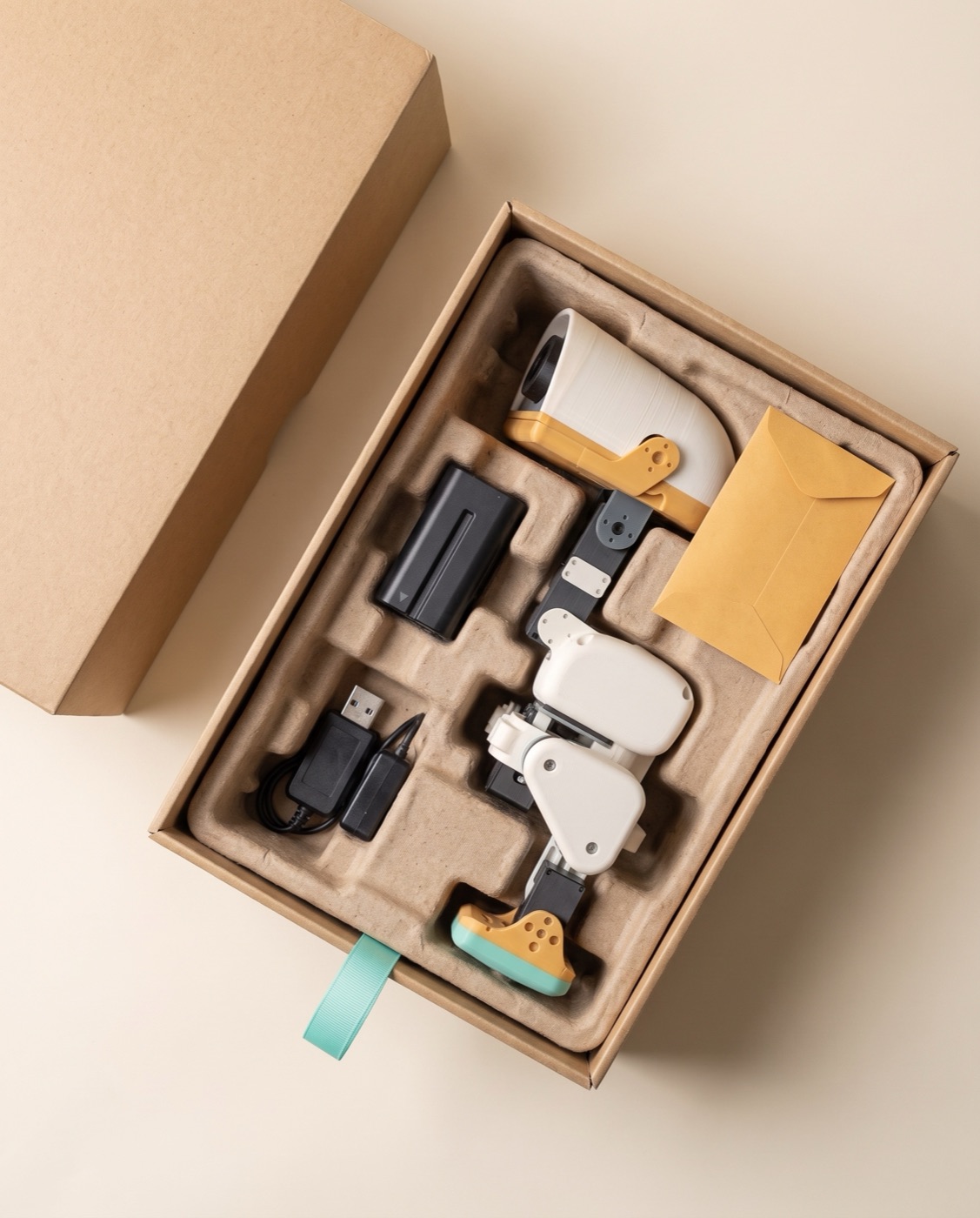
Moulded pulp, a cavity for battery and charger, a mint pull ribbon.
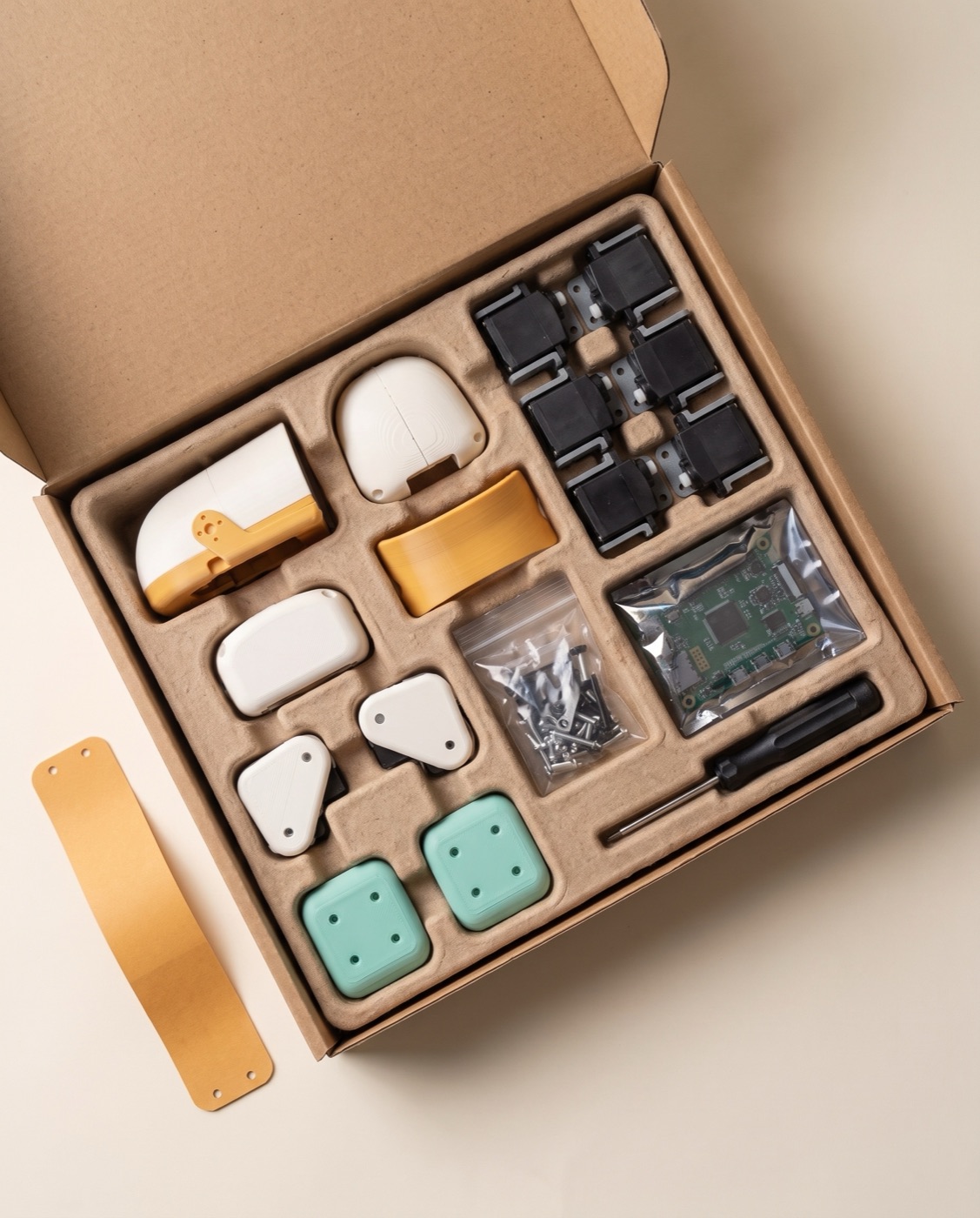
Flat box, printed parts and servos sorted in pulp compartments.
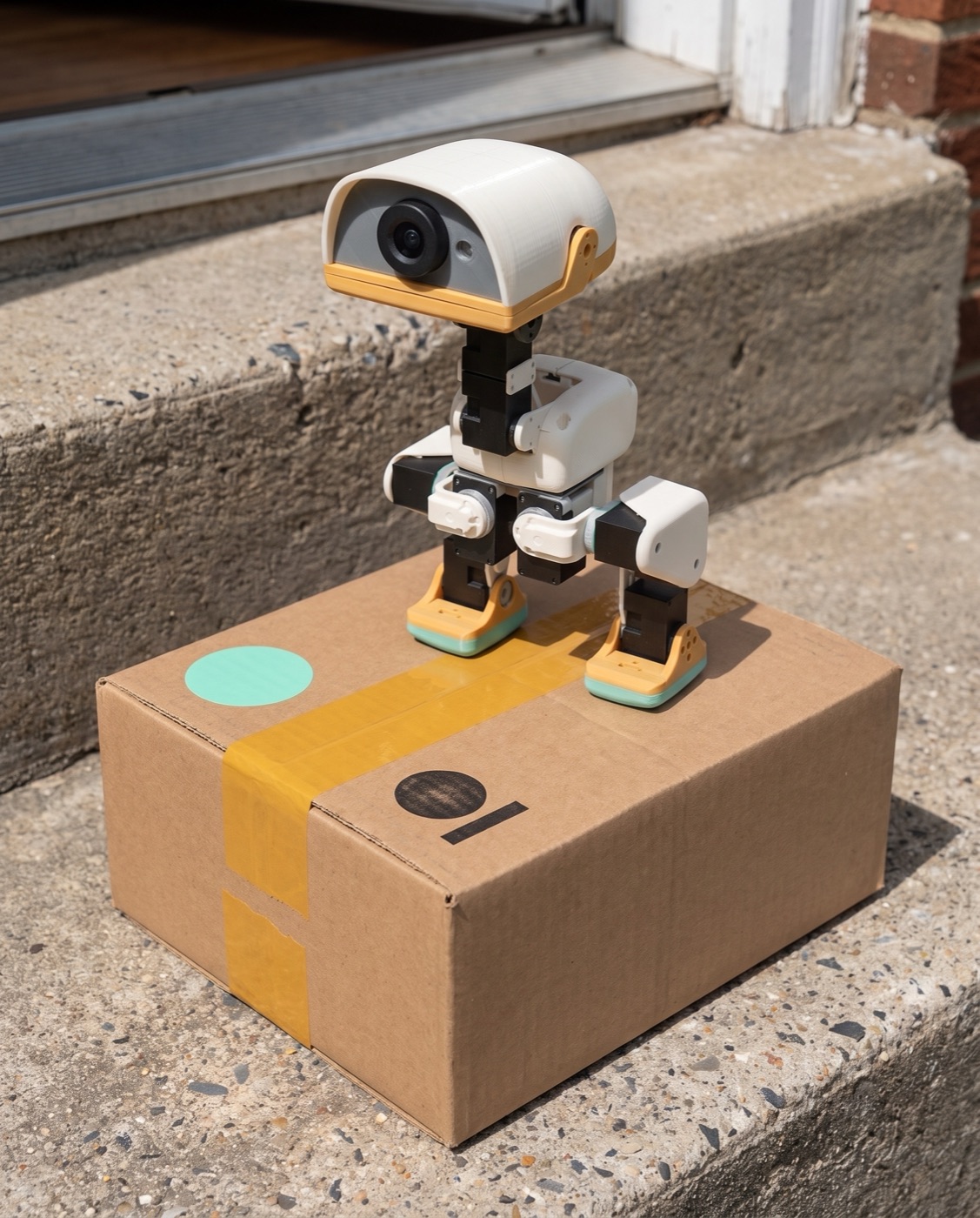
Plain carton, amber paper tape, mint sticker, stamped mark.
Repo and credit
Everything lives in one git repo
CAD source for every part, 103 drawing sheets, the simulation model, print plates with their validation records, the sourcing notes and the brand round.
github.com/Leif-Rydenfalk/microduck
The repo is private. Ask Leif for access.